
It was a blistering hot day on the Stamp Seeds farm near Hays, but it was not enough to deter local farmers who were eager to learn.
The Stamp family was excited to invite people out to their field to check out the Enhanced Efficiency Fertilizer (EEF) project, which is being carried out by Farming Smarter.
Nathan Stamp says the project has provided him with valuable information that will assist him in his operations and was eager to help put on the Fertilizer Field Day event on May 27 to share that knowledge with anyone who was interested.
“For us farmers, it's hard to sometimes get off the farm and think about trying new things. You kind of have a plan, and you stick with it, and so something like this is actually nice to go outside your realm of thinking and look at different options,” says Nathan Stamp.
George Joseph Jr., Field Technician at Farming Smarter, explains that the goal of the EEF project is to test if we can safely reduce nitrogen inputs on winter wheat without compromising yield and quality. If so, farmers could potentially save some money on fertilizers.
He says he wanted to work with a local farmer for this project to give a more specific context for their practices, cropping systems, equipment, and more.
“Different provinces have different soil conditions, and even within a province, the soil conditions will change quite a bit from the north to the south, so being able to do these region-specific trials gives farmers an idea of what will work on their farm,” Joseph adds.
For this trial, we are comparing two different types of nitrogen fertilizers at two application rates in a winter wheat field. We are testing a Urea fertilizer at a 100% and an 80% application rate, as well as a SuperU-equivalent enhanced efficiency fertilizer at a 100% and an 80% rate. There is also a small section that has no added nitrogen.
Not only do we hope to see whether nitrogen inputs can be reduced, but also what differences there might be between the Urea and EEF products at each application rate.
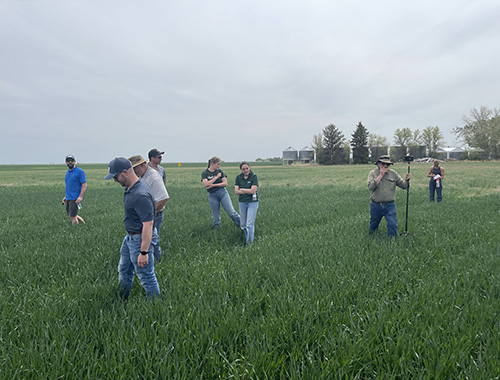 |
| Guests at Fertilizer Field Day tried to figure out which sections utilized which nitrogen treatments. Can you tell the difference? |
Upon a quick visual inspection, it was difficult to see which winter wheat plants had received the 80% or 100% treatments. Meanwhile, our control plot that had no additional nitrogen was a square beacon of lighter crops within the field, and the crop quality was noticeably worse.
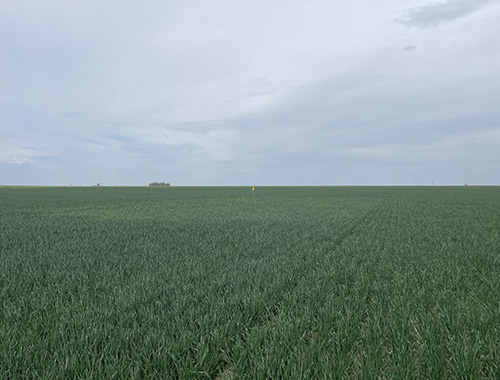 |
| This small section with no added nitrogen had noticeably worse crop quality than those that had received fertilizer. |
We will, however, need to wait until the crops are fully matured to measure any differences in yields and quality.
After Joseph and Farming Smarter Field Tested Manager Lewis Baarda presented the latest project updates, they opened the floor to questions and for people to share their thoughts and comments.
Among the attendees was Glenn Tuink from Groten Hay Farms in the Picture Butte area.
It was Tuink’s first time attending a Farming Smarter event, and he was eager to grow his general knowledge base and to see if there was anything he could take back to his operation.
Tuink says he loved having the opportunity to network and share wisdom back and forth with the other attendees.
“The thing that I love the most about it is just talking to different farmers. ‘How do you do this? How do you do that? How do you work your fields, and how do you level them out,’ and just general knowledge is a big thing for me,” says Tuink.
Farming Smarter’s Knowledge & Network team exists for this very reason. We believe that the transfer of knowledge isn’t the end of a project – it’s just the beginning. We aim to connect forward-thinking people who relentlessly pursue innovation, just as we do, to drive the future of sustainable agricultural practices.
One way in which we do this is by hosting educational events throughout the year, such as Pivot School on June 3. Sean Zdun with Pivot Pro Ag will help irrigated farmers to understand how their pivots work and troubleshoot common issues.
Farming Smarter Field School returns on June 25 and July 16. The events offer a full day of research updates and in-field demonstrations with speakers and guests who are interested in learning more about agriculture and ag-related products.
You can learn more about these events and register to attend here.
Fertilizer Field Day, and the EEF project, is done in partnership with Farmers for Climate Solutions (FCS) and their Farm Resilience Mentorship (FaRM) program. It provides farmers and ranchers opportunities to connect, learn and share knowledge through in-person events and online courses with its FaRM Learning Hub. More details here.
|
|
|
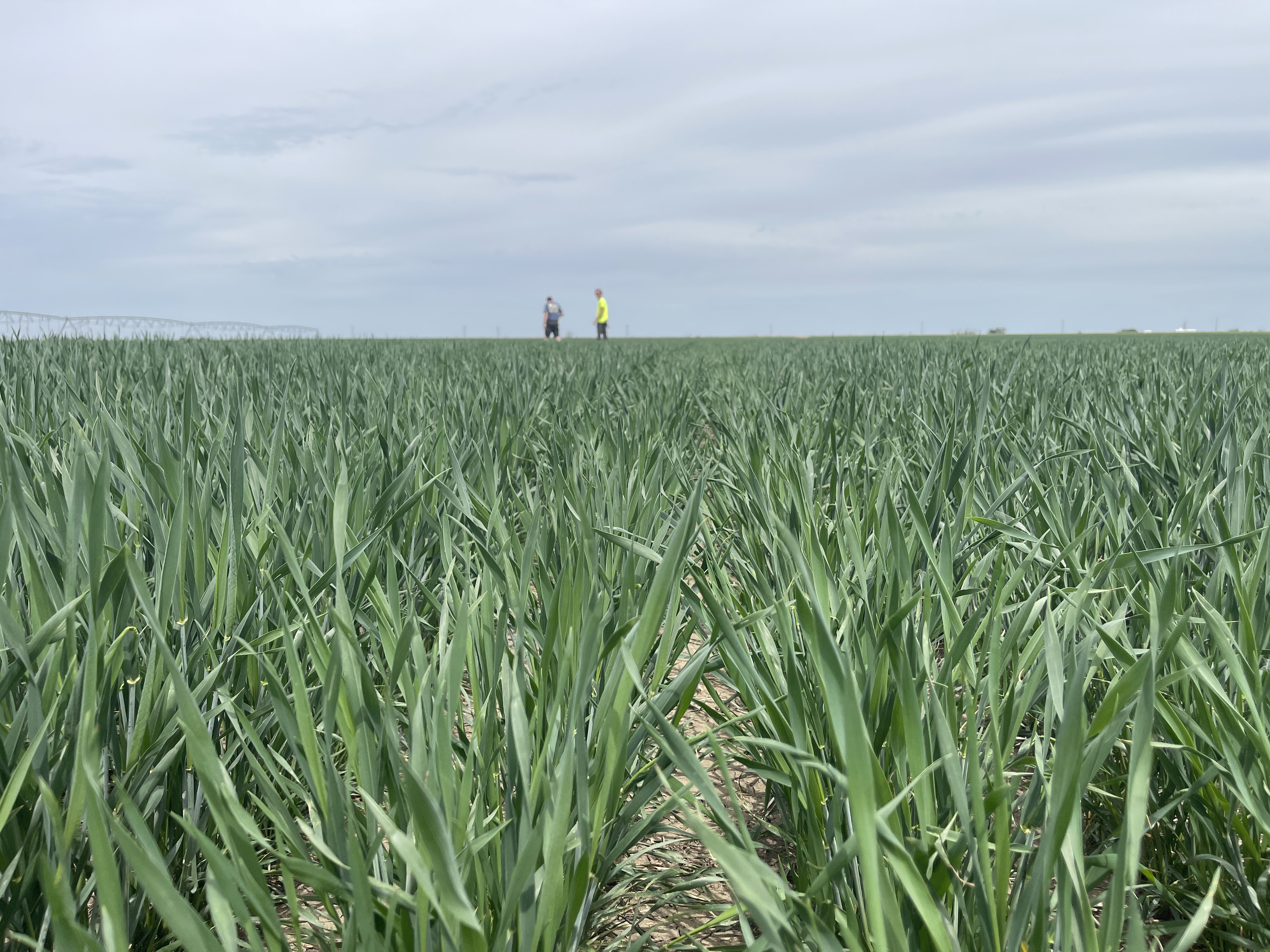
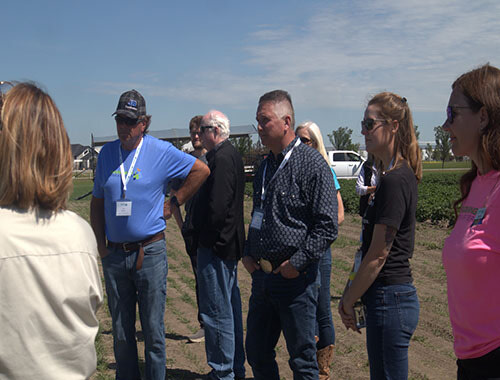
Fertilizer Field Day attendees check out the Enhanced Efficiency Fertilizer project. |
|
|
Building and Inspiring a Culture of Innovation in Western Canada AgricultureFarming Smarter is an agriculture innovation hub based out of Lethbridge, Alberta. Our mission is to support the people involved in advancing irrigated and dryland crop production. We work closely with farmers, entrepreneurs, businesses, government, academia and more to bridge the innovation gap, drive economic growth, improve social impact and environmental sustainability. We are a policy governed, non-profit organization with by-laws under the Alberta Societies Act, and a Canadian Charity registered under the Canada Revenue Agency. If you like what we do, please consider supporting Farming Smarter by making a donation, sponsoring us, or come to us for your agricultural research needs. Innovation is hard and about long-term results. We invite anyone interested in agriculture innovation to work with us and together we can change the way people farm. |

Other Articles
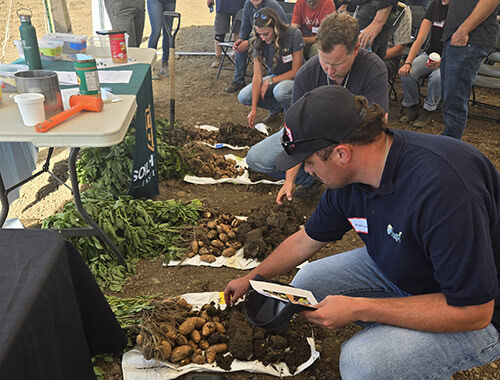
In agriculture, local conditions require local solutions. Specialty crops like potatoes and sugar beets underpin entire processing industries in southern Alberta yet lack region-specific information. Farming Smarter is working with these industries to provide that information and fill the "crop development holes".
The Honourable Heath MacDonald, federal Minister of Agriculture and Agri-Food, visited Farming Smarter's research farm in Lethbridge to experience first-hand the value and impact of active collaboration in agronomy research.

Meet the experts ready to share their wisdom with you in the field at the Farming Smarter Field School on July 16! Don't wait to grab your tickets!