
If you’re looking to acquire land for your farm, be prepared to pay up.
Farm Credit Canada (FCC) has released its 2025 FCC Farmland Values Report, which tracked changes in average farmland values across the country between Jan. 1 and Dec. 31, 2025.
Nationally, the average cost to buy farmland increased by 9.3 per cent in 2025, which was propped up by the prairie provinces of Manitoba (+12.2%), Alberta (+11.4%) and Saskatchewan (9.4%).
British Columbia was the only jurisdiction to see prices fall, decreasing by 1.7% annually.
For Alberta, the 11.4% jump was the biggest since at least 2016.
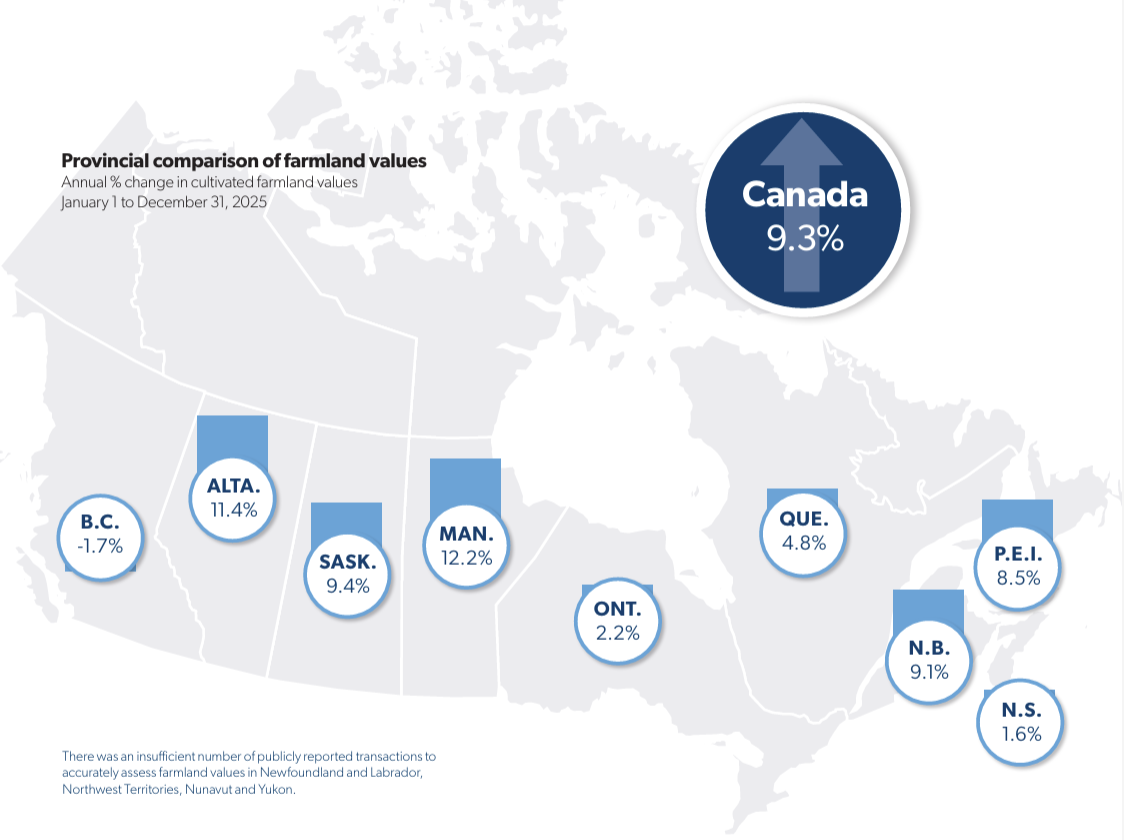 |
| Provincial comparison of farmland values changes in 2025. Credit: Farm Credit Canada |
The cost to buy cultivated land in southern Alberta went up 16.4 per cent year-over-year to an average of $5,800 per acre. Depending on the plot and location, it could go as high as $9,400.
Irrigated land in the region also rose by 11.3% to $20,000 per acre.
Ken Coles, Executive Director at Farming Smarter, says the recent expansion of irrigation infrastructure and the potato industry are at least part of the reason these numbers have gone up by so much.
"Those high-value crops are increasing the competition for land, which is basically raising the price," says Coles. "Irrigated land is certainly attractive, and I think the proximity to irrigated land is probably artificially raising the price of our dryland, because, right next door to an irrigated field, you'll have a dryland field that's probably a little bit more expensive than it should be."
This cost, he believes, could make getting into agriculture harder than ever.
"It almost makes it impossible, to be honest with you. It's so capital-intensive, especially here in southern Alberta with the high-priced irrigated lands. To be getting into farming, that's a tough game."
Existing farmers who already own land can enjoy the increased equity that comes with higher farmland values, and those looking to sell their land in retirement can expect a pretty penny. However, Coles says farmers will have a difficult time buying new plots to expand their output.
Pasturelands in southern Alberta experienced a more moderate increase of 3.5 per cent in Alberta to $4,100 per acre.
The report from FCC notes that this was supported by strong cattle prices and constrained land availability. These plots in the southern and central regions are increasingly being acquired for residential or recreational use, further reducing the availability of true pasture.
Coles says that, as farmlands continue to become more expensive, grocery prices will be pushed up farther.
"The more expensive it becomes to raise crops - that's all going to get passed onto consumers eventually. That, on top of high fertilizer prices and high fuel prices, unfortunately, I don't expect food prices to be going down," Coles notes.
Trade uncertainty, tariffs, high input costs and softer commodity prices remain important risks to monitor, but the FCC says they have not materially dampened buyer interest or overall farmland values.
You can access the full 2025 FCC Farmland Values Report here.
|
|
Building and Inspiring a Culture of Innovation in Western Canada AgricultureFarming Smarter is an agriculture innovation hub based out of Lethbridge, Alberta. Our mission is to support the people involved in advancing irrigated and dryland crop production. We work closely with farmers, entrepreneurs, businesses, government, academia and more to bridge the innovation gap, drive economic growth, improve social impact and environmental sustainability. We are a policy governed, non-profit organization with by-laws under the Alberta Societies Act, and a Canadian Charity registered under the Canada Revenue Agency. If you like what we do, please consider supporting Farming Smarter by making a donation, sponsoring us, or come to us for your agricultural research needs. Innovation is hard and about long-term results. We invite anyone interested in agriculture innovation to work with us and together we can change the way people farm. |